What is a CV? Meaning, what to include and how it differs from a resume
Updated 25 October 2026 · 9 min read
A CV is a short document, usually one or two pages, that sums up your skills, work experience and qualifications so an employer can decide whether to invite you to an interview. CV stands for curriculum vitae, Latin for roughly “the course of your life”, and in the UK it is the standard document you send when you apply for most jobs.
So what is a CV in practice? It is a sales document, not a life story. It doesn’t list everything you’ve ever done. It picks out the parts of your experience that matter for the job you want. This guide explains what a CV is for, what goes on one, how it differs from a resume, a cover letter and an application form, and how to start your own.
What does CV stand for?
CV is short for curriculum vitae. The phrase comes from Latin: curriculum means a course or a run, and vitae means “of life”. The plural is curricula vitae, but almost everyone in the UK just says “CVs”.
Nobody writes “Curriculum Vitae” at the top of the page any more. A modern UK CV uses your name as the heading, because the reader already knows what the document is.
What a CV is for, and who reads it
A CV has one purpose: to get you an interview. It won’t get you the job on its own, but it decides whether you get the chance to talk to the employer at all. Knowing who reads it, and how, explains most of the rules about what a CV should look like.
- Recruiters and hiring managers often have many applications for one job. They skim each CV quickly for the job title, the most recent role and the skills the advert asked for, so those need to be easy to find near the top of page one.
- Applicant tracking systems (ATS) are software that many larger employers and agencies use to store and sort applications. Some search or rank CVs by the words they contain, which is why a plain layout and the advert’s own wording (where it’s true for you) both help.
- Interviewers use your CV as a script. They pick lines from it and ask you to explain them, so everything on it should be something you can talk about with confidence.
What is on a CV
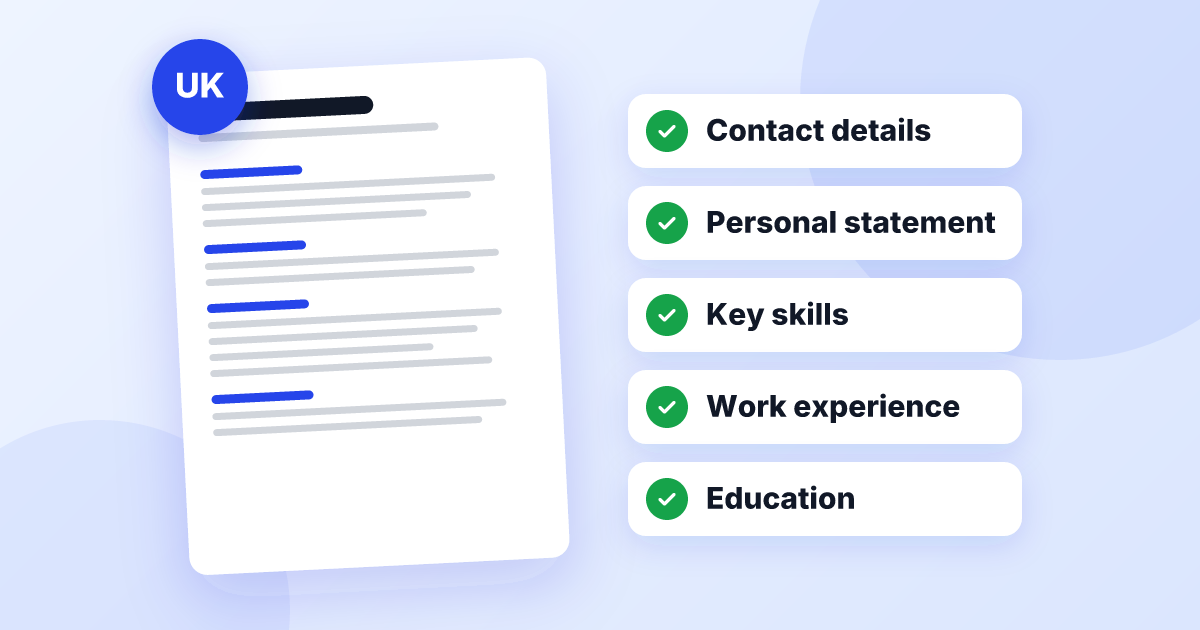
UK CVs follow a familiar order, which makes them quick to read. A standard CV includes:
- Your name and contact details: town or city, mobile number and email address, plus a LinkedIn link if you have a complete profile.
- A personal statement: three or four lines saying who you are, what you offer and what kind of job you want.
- Key skills: a short list of specific, checkable skills, such as software, licences or techniques.
- Work experience: your jobs, newest first, each with the job title, employer, place, dates and a few bullet points about what you did and achieved.
- Education and qualifications: your highest or most recent first, such as a degree, A levels, a BTEC or an NVQ, then GCSEs (graded 9–1 in England). In Scotland, list your Highers and National 5s.
- Additional information (optional): languages, a driving licence, and certificates or checks the job needs, such as a CSCS card, an SIA licence or first aid.
If you have little work history, education moves up above experience. For what to write in each of these sections, step by step, see our guide on how to write a UK CV.
What UK CVs leave out
In the UK, a CV normally has no photo, date of birth, age, marital status, religion or nationality, and no National Insurance or passport number. The Equality Act 2010 protects job applicants from discrimination on grounds such as age, race, religion and sex, and employers don’t need these details to judge whether you can do the job.
What a CV looks like: a short example
Here is a complete one-page CV, so you can see how the sections fit together. The employers are described rather than named; on your own CV you would use the real names.
Marcus Reid
Swansea · 07700 900812 · marcus.reid@example.com
Personal statement
Multi-drop delivery driver with three years’ experience on parcel and grocery routes across South Wales, completing 80 to 120 drops a day in a 3.5-tonne van. Clean full UK driving licence and a strong record for on-time deliveries and careful handling. Looking for a driving role with a regular route and the chance to train towards a Category C licence.
Key skills
Multi-drop route planning · Handheld scanners and proof-of-delivery apps · Vehicle walk-round checks · Manual handling · Cash and card payments on delivery · Customer service on the doorstep
Work experience
Delivery Driver — regional parcel delivery firm, Swansea · Aug 2023 – Present
• Deliver 80 to 120 parcels a day across urban and rural routes in a 3.5-tonne van
• Plan the order of drops each morning to avoid school-run traffic and repeat visits
• Complete daily vehicle checks and report defects before leaving the depot
Grocery Delivery Driver — supermarket home delivery service, Neath · Mar 2022 – Jul 2023
• Delivered chilled, frozen and ambient orders to booked time slots
• Carried orders to the door for elderly and disabled customers and checked substitutions with them
Earlier experience
Warehouse Picker — distribution centre, Port Talbot · 2020 – 2022
Education
6 GCSEs including English Language and Maths — secondary school, Swansea
Additional information
Full UK driving licence (no points) · Manual handling certificate · Conversational Welsh
Notice what it does: a reader can tell in seconds what this candidate does, how much experience they have and what they want next. For a longer, two-page CV with notes on every section, see our full UK CV example.
CV or resume: what’s the difference?
This confuses a lot of people who have job hunted in another country. The short answer:
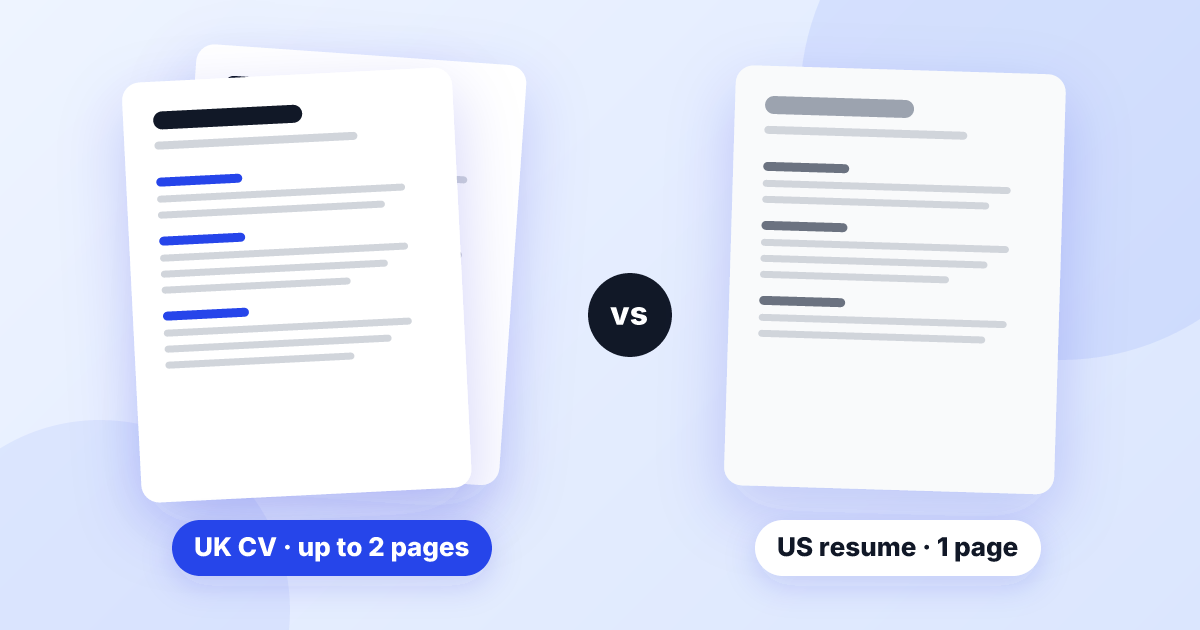
- In the UK and Ireland, “CV” is the everyday word for the one- or two-page document you send with job applications. Most British employers don’t use the word “resume”, though they’ll know what you mean.
- In the US and Canada, that same kind of document is called a resume, and it is often kept to one page. There, a “CV” usually means a longer academic or medical document listing research, publications and teaching.
- In other countries, the two words are often used loosely, so check what a local employer expects.
For UK jobs, call it a CV and follow UK conventions. Our UK CV vs US resume guide lists every change to make if you’re converting a resume.
Academic CVs are different
CV vs cover letter, application form and LinkedIn
A CV usually works alongside other documents. Each one has a different job:
- Cover letter: a short letter, no more than a page, written for one specific job. It says why you want this role and picks out the two or three parts of your CV that fit it best. Our guide on how to write a cover letter has a full example.
- Application form: the employer’s own set of questions. Many public sector and large employers use these instead of, or as well as, a CV, and score your answers against the job criteria. You can copy dates, job titles and achievements across from your CV.
- Supporting statement or personal statement for a form: a longer piece of writing, often requested on NHS and public sector applications, explaining how you meet each criterion. This is different from the three-line personal statement at the top of a CV.
- LinkedIn profile: a public online profile that recruiters can search. It can say more than your CV, but the job titles and dates should match.
What a CV is not
The most common mistake people make with their first CV is treating it as a complete record of their life. It isn’t. A CV is a selection, aimed at a particular kind of job.
Weak
Strong
The strong version tells the employer something useful in one line. The weak one uses two sentences and still doesn’t say what the person can do. A CV also isn’t:
- fixed: adjust it for each type of job you apply for
- a list of duties copied from old job descriptions: show what you did and, where you can, the result
- the place for references, salary history or reasons for leaving: employers ask about those later
For page settings, fonts and the three main CV formats, see our guide to the UK CV format and layout.
When you need a CV, and when you don’t
You’ll usually need a CV when:
- a job advert asks you to “send your CV” or upload one
- you register with a recruitment agency
- you apply through a job board or LinkedIn
- you contact an employer speculatively or hand your details in at a shop or site office
You may not need one when the employer uses its own application form, which is common for NHS, civil service, council and school jobs. If a form says CVs won’t be accepted, don’t attach one. Even then, an up-to-date CV saves time, because the details you need to copy are all in one place.
How to make your first CV
If you’ve never written a CV before, these steps will get you from a blank page to a first draft:
- Decide what kind of job you’re applying for. A CV aimed at one type of job is far stronger than one aimed at “anything”.
- Read three or four adverts for that job and write down the skills and requirements they repeat.
- List every job, placement, volunteering role and qualification you have, with month and year dates.
- For each job, write two to five bullet points about what you did, starting with an action word such as “served”, “trained” or “organised”, and add a result or a number where you honestly can.
- Write a three- or four-line personal statement last, once you can see your strongest material.
- Put it in the standard order, in one plain font, on no more than two sides of A4.
- Check the spelling with your spell checker set to English (UK), then ask someone else to read it.
- Save it as a PDF with your name in the file name, such as Marcus-Reid-CV.pdf.
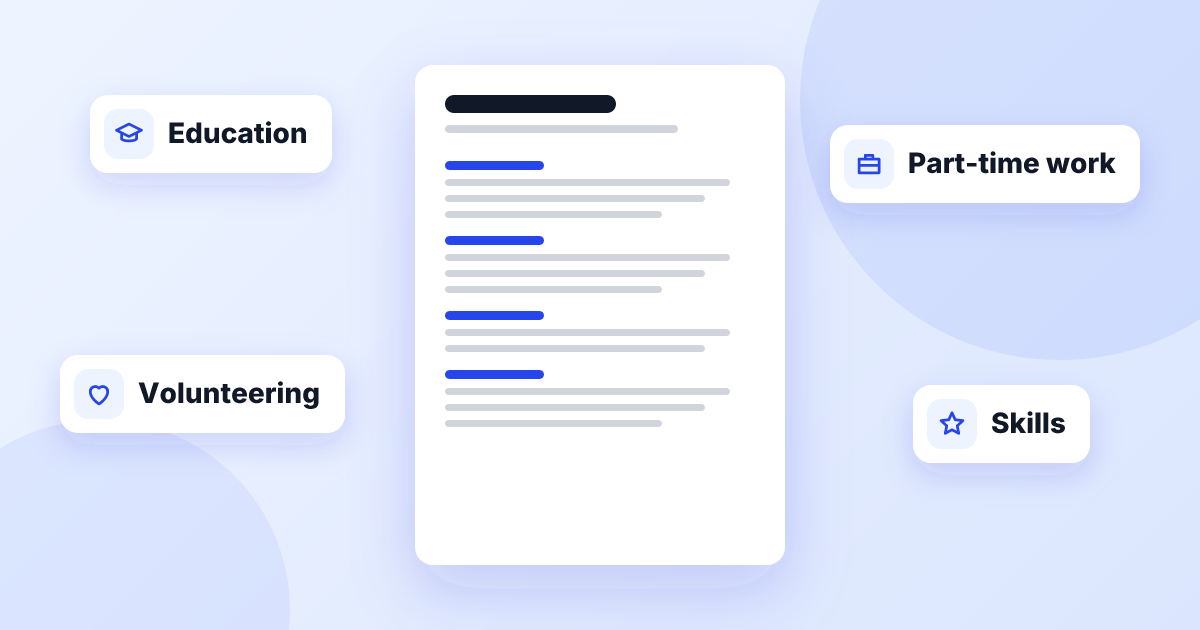
Starting with no paid work at all? Our guide to writing a CV with no work experience shows how to turn school, volunteering and part-time work into a strong first CV.
If you’d rather not start from a blank page, you can get your CV ready for UK employers with UK CV Fix. Upload an old CV or resume, or answer a few questions, and we’ll turn it into a UK-format CV for the job you want, ready to download as Word or PDF.
So, what is a CV? It’s a short, focused summary of your skills, experience and qualifications, written to win you an interview for a particular kind of job. Keep it to two pages or fewer, put your strongest material first, leave out personal details, and update it every time you apply.
Frequently asked questions
What does CV stand for?
CV stands for curriculum vitae, a Latin phrase that roughly means "the course of your life". In everyday UK use, people just say CV.
Is a CV the same as a resume?
In the UK, the document you send for most jobs is called a CV, and it does the same job as what Americans call a resume. In the US, a CV usually means a longer academic document, so the words are not quite interchangeable there.
How long is a CV in the UK?
Usually no more than two sides of A4. One page is fine for students, school leavers and people with little work history.
Do I need a CV for every job?
Not always. Many NHS, civil service, council and large-employer jobs use an online application form instead, and some shop or hospitality jobs let you apply in person. It is still worth having an up-to-date CV, because you can copy your details from it and many employers and agencies will ask for one.
What is the difference between a CV and a cover letter?
A CV is a summary of your skills, work history and qualifications that you can adapt for each job. A cover letter is a short letter written for one specific job, explaining why you want it and how you fit what the advert asks for.