How to write a UK CV in 2026: a step-by-step guide
Updated 25 October 2026 · 6 min read
A UK CV has one job: to get you an interview. Recruiters often skim a CV in under a minute, and many employers run applications through screening software first, so a CV that is clear, well-ordered and relevant beats one that is long or clever. This guide walks through exactly what to include, in what order, and what to leave out.
New to CVs altogether? Start with what a CV is and what it’s for.
Length and layout
- Two sides of A4 is the standard for most people. One page is fine for school leavers and students. Senior roles can stretch further, but only if every line earns its place.
- Reverse-chronological order: your most recent job and qualification come first.
- A plain, readable layout: a standard font such as Calibri or Arial at 10–12pt, clear headings, and bullet points. Avoid tables, text boxes, columns made of tables, and graphics — they can scramble when screening software reads your CV.
- British English: “organised”, “programme”, “licence” (noun). Recruiters notice US spellings.
- Save it as a PDF or Word file with a sensible name, such as Sarah-Mitchell-CV.pdf. If a job advert asks for Word, send Word.
For page settings, heading styles and when to use a skills-based layout instead, see our guide to the UK CV format and layout.
What to leave out
UK employers are not allowed to make hiring decisions based on things like age, marital status or nationality, so the convention is to leave them off entirely:
- a photo
- your date of birth or age
- marital status, dependants or religion
- your full home address — your town or city is enough
- your National Insurance number
- salary history
- the word “CV” or “Curriculum Vitae” as a heading — your name is the heading
Right to work
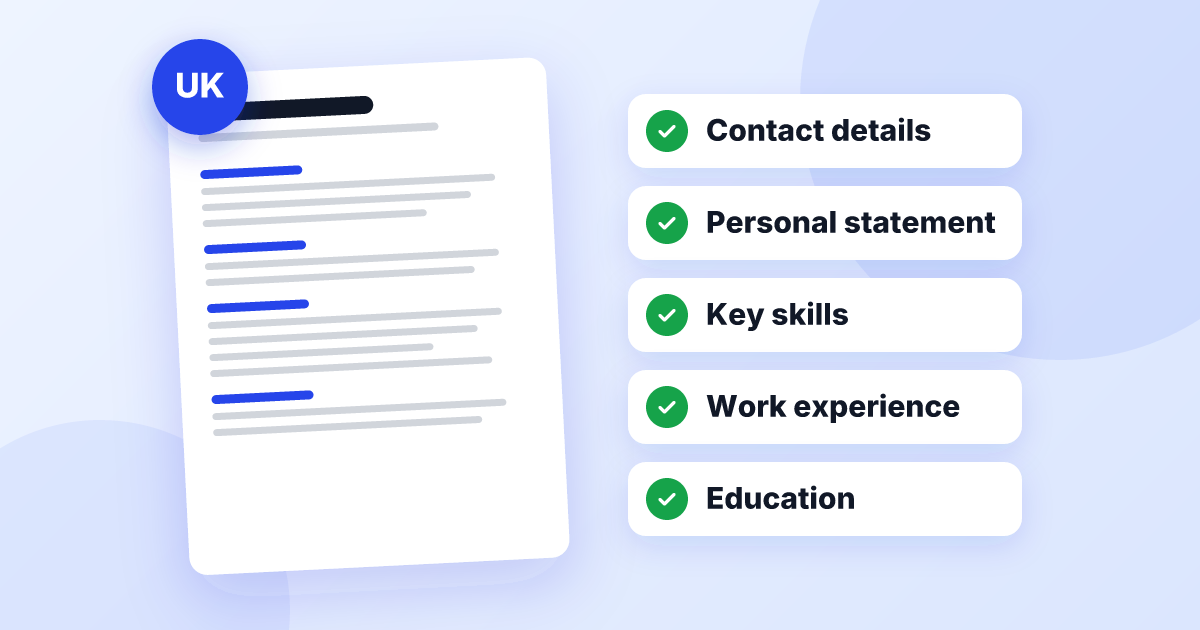
The sections, in order
To see these sections filled in for a real-looking candidate, look at our full UK CV example.
1. Name and contact details
Your name in large text at the top, then on one line: town or city, mobile number, a professional email address and, if you have a complete profile, your LinkedIn URL.
2. Personal statement (or profile)
Three or four lines summarising who you are and what you’re looking for. More on this below.
3. Key skills
Six to ten specific skills, ideally matching the words in the job advert: “stock control”, “Microsoft Excel (pivot tables)”, “safeguarding”, “forklift (counterbalance) licence”. Avoid vague ones such as “hard-working” — show those through your experience instead.
4. Work experience
For each role: job title, employer, location and dates (month and year), followed by three to six bullet points. Go back about 10–15 years in detail; older roles can be summarised in a line each.
5. Education and qualifications
Your highest or most recent qualification first. Students and recent graduates should include more detail, such as degree classification, relevant modules or a dissertation. Experienced candidates can keep this short — for school qualifications, a single line such as “9 GCSEs including English and Maths (grades 9–5)” is plenty. In Scotland, list your Highers (and Advanced Highers) the same way.
6. Additional information (optional)
Useful extras that don’t fit elsewhere: languages, a full UK driving licence, DBS check, first aid, CSCS card, volunteering, or relevant interests. Keep it specific — “enjoys reading and socialising” adds nothing.
7. References
You don’t need to list referees on your CV — employers will ask for them later if they offer you the job. You can leave this section off and use the space for something more useful.
Writing your personal statement
This is the first thing a recruiter reads, so make it specific. A good formula is: who you are + what you bring + what you’re looking for. Many UK CVs drop “I” for a crisper style (“Retail supervisor with…”), but writing in the first person is fine too — just keep it consistent and don’t start every sentence with “I”.
Weak
Strong
The weak version could describe anyone. The strong one tells the recruiter, in three sentences, exactly what this person has done and where they fit.
Writing your work experience
Each bullet point should show what you did and the result. Start with an action verb (managed, trained, reduced, organised, resolved) and add a number wherever you honestly can.
Weak
Strong
Weak
Strong
Never invent numbers
If you have a gap in your work history, a short honest line is better than leaving it unexplained — for example “Career break to care for a family member (2023–2024)”.
Tailoring it to each job
Sending the same CV to every job is the most common reason good candidates get rejected. Before each application:
- Read the job advert and note the skills and keywords it repeats.
- Make sure those words appear in your personal statement, skills and experience — where they are true for you.
- Move your most relevant achievements to the top of each job.
- Cut anything that doesn’t help for this particular role.
This matters doubly because many employers use applicant tracking systems (ATS) that compare your CV against the job advert. Our guide on writing a CV with no work experience covers how to do this when you’re just starting out.
Final checklist before you send it
- No more than two pages, with the most important information on page one
- Your name, phone number and email are correct — test them
- No photo, date of birth or other personal details
- British spelling, and no typos (read it aloud, or ask someone else to check)
- Dates are consistent (e.g. “Mar 2022 – Present” everywhere)
- Tailored to this specific job
- Saved as a PDF or Word file with your name in the file name
Most applications go in with a short letter alongside the CV. Our guide on how to write a cover letter for UK jobs has a full example to follow.
Bilal Hussain
Bradford · 07700 900789 · bilal.hussain@example.com
Senior care assistant with four years’ experience in domiciliary and residential care, supporting clients with personal care, medication and dementia. NVQ Level 3 qualified, full UK driving licence, and fluent in English, Urdu and Punjabi. Looking for a senior care role with a supportive home care provider.